SDN-microSENSE
Project Description
The advanced automation equipment that is used to control the new segments of the interconnected grid (smart inverters, Programmable Control Units – PLCs, Remote Terminal Units – RTUs), increase the attack surface, and the fluctuations observed in the renewable energy sources introduce significant challenges in terms of ensuring the security and stability. SDN-microSENSE aims at providing and demonstrating a secure, resilient to cyber-attacks, privacy-enabled, and protected against data breaches solution for decentralised Electrical Power and Energy Systems (EPES). All designed, developed, and tested technologies should consider the latest related research findings and maintain high compliance with current industrial standards (e.g., IEC standards).
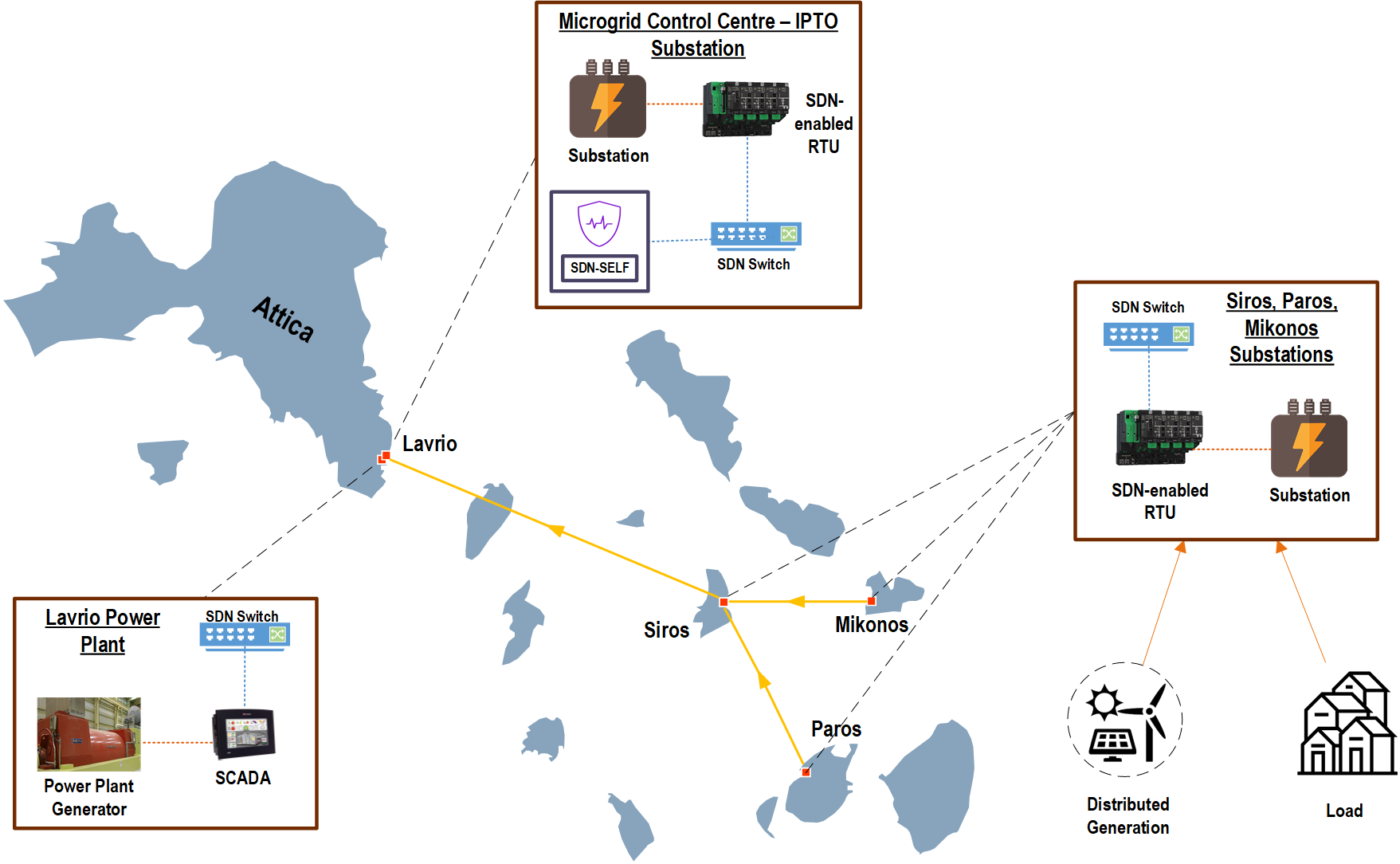
IPTO participates in the 3rd pilot of SDN-microSENSE, in collaboration with the Public Power Corporation (PPC) describing a real-life and large-scale pilot, involving the Lavrio power plant, the Lavrio substation, and three islands of Cyclades (Syros, Mykonos and Paros). This pilot concerns the validation of the SDN-microSENSE platform in the new interconnection of the Cyclades islands with the mainland. The SDN-microSENSE platform will be deployed in the IPTO substation in Lavrio, the interconnection points of Cyclades and the mainland, where real-time electricity measurements will be collected and analysed by leveraging the novel SDN-enabled RTUs provided by Schneider Electric, enhanced with new cybersecurity functionalities.
Project Information
| Budget | |
| 253.750 € (DRTD) | 8.000.000 € (Total) |
| Dates | |
| Start: 07/2019 | Duration: 36 Months |
| Participants | |
| 15 Countries | 30 Partners |
| Coordinator | |
| Ayesa | |
| Website | |
| SDN-MicroSENSE | |
News - Announcements
- 05/09/2022:
Use Case 3 of SDN-microSENSE, “Large-scale Islanding Scenario Using Real-life Infrastructure”, which is taking place in Greece, concerns the validation of the SDN-microSENSE platform in the new interconnection of the Cyclades islands with the mainland. This interconnection is one of the most important interconnection projects both at national and European level. The project is co-funded by EU and managed by the IPTO and is expected to be completed in 2024, bringing significant advantages for Greece in: reducing energy costs, the reduction of the environmental impact in the islands by the decommissioning of the polluting old diesel generators, reducing the dependence on fuel imports and in general bringing new opportunities for the development of new large-scale projects to maximise the renewables potential of the islands, resulting to a cleaner energy mix and new jobs.
In order to validate the SDN-microSENSE platform, this use case consists of four scenarios for responding to emergencies that affect the Lavrio-Cyclades interconnection in Greece, including the region of Lavrio and the three interconnected islands of Cyclades. It is assumed that a cyberattack or significant failure causes Lavrio and the Cyclades islands to be disconnected from the national grid. The SDN-microSENSE platform is employed in order to propose the appropriate mitigation actions to prevent cascading effects, including the black start of the backup power plant of PPC in Lavrio as well as the formation of the optimal islanding scheme to maintain grid health. As a result, SDN-microSENSE will guarantee the availability of the electrical network and prevent a total blackout.
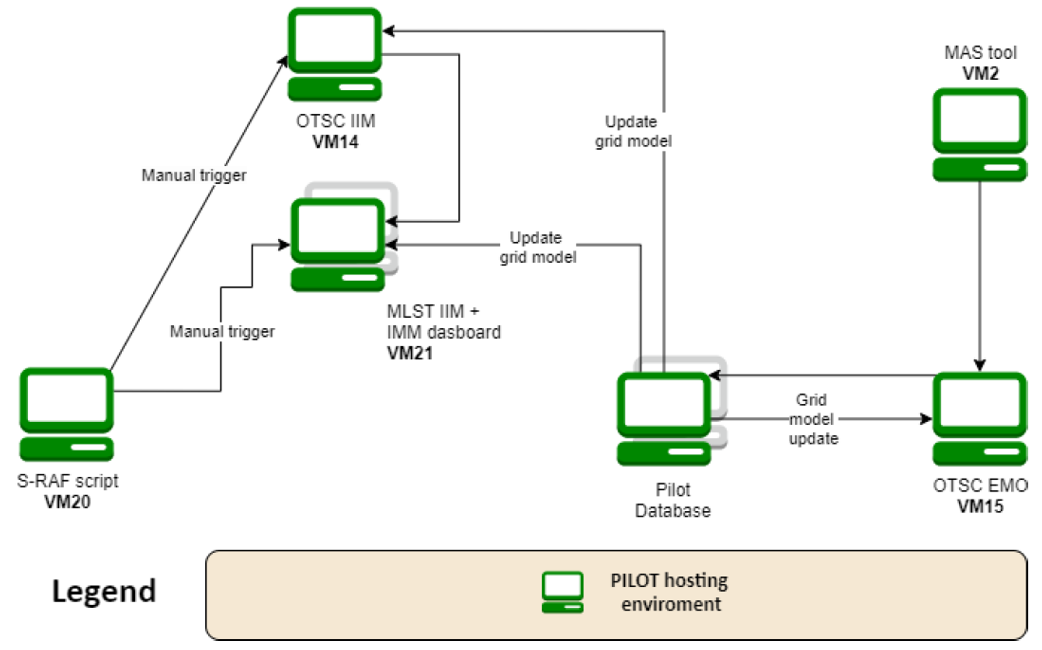
All the involved SDN-microSENSE components and complementary software, were deployed on IPTO’s premises. Figure 2 depicts the deployment of SDN-microSENSE in more detail. In particular, the SDN-microSENSE Risk Assessment Framework (S-RAF) is the component that provides the relevant security alerts that indicate a serious event, the Optimization Tool for Self-healing and Clustering (OTSC) and Machine Learning Suite Tool (MLST) in the Islanding and optImisation fraMework (IIM) implement alternative methods for calculating the optimal islanding schemes. Finally, the Multi Agent System (MAS) and the OTSC Energy restoration and Management prOcesses framework (EMO) tools provide suggested energy restoration schemes for each island to ensure load and supply balance. Experimental results have validated the mitigation actions proposed by the SDN-microSENSE platform, to prevent cascading effects in the transmission system. Mitigation actions include the proposal of optimal islanding schemes, in respect to low number of disconnected lines, low power imbalance as well as the successful restoration of the load/supply balance and an overall low computational time.
The scenarios carried out are summarized as follows:
Scenario #1: This scenario aims to validate the ability of SDN-microSENSE to calculate optimal islanding schemes. According to the execution conditions of this test, the Cyclades-Lavrio interconnection is under normal operation and connected to the rest of the grid.
Assuming that a cyberattack or a significant failure occurs, S-RAF delivers the security incident to IIM that will initiate the calculation of an islanding scheme to isolate Cyclades islands and Lavrio from the national grid. Then, MAS, in an asynchronous manner, gets the updated grid model and computes the new load/supply balance, suggesting the appropriate actions to restore grid stability.
Scenario #2: This scenario aims to validate the ability of SDN-microSENSE to calculate optimal islanding schemes. In comparison with Scenario#1, this scenario will further test the calculation of optimal islanding schemes in a more complex cases that also involve Distribution Energy Resources (DERs), thus providing insights about the infusion of renewables in the interconnected islands. According to the execution conditions of this test, the Cyclades -Lavrio interconnection is augmented with simulated and existing DERs on the islands.
Assuming that a cyberattack or a significant failure occurs to the islanded microgrid, S-RAF delivers the security incident to IIM that will initiate the calculation of an islanding scheme. Then, MAS, in an asynchronous manner, gets the updated grid model, computes the new load/supply balance, and suggests the appropriate set points for DERs to restore grid stability regarding voltage and frequency.
Scenario #3: This scenario aims to validate the ability of SDN-microSENSE to respond to unexpected successive events that cause loss of load and supply balance.
According to the execution conditions of this test, the Cyclades -Lavrio interconnection is already disconnected from the rest of the grid and an islanding scheme has already been applied. Assuming that consecutive failures cause significant changes on load and supply balance, MAS detects these changes and recommends the appropriate set points for DERs to restore energy balance and ensure grid stability regarding voltage and frequency of the system.
Scenario #4: This scenario aims to validate the ability of SDN-microSENSE to calculate optimal islanding schemes with different seasonal profiles.
![sdnusecase3]()
Deployment scheme of SDN-microSENSE components for use case 3
- 27/08/2021: Commencement of Pilot 3: “Large-scale Islanding Scenario Using Real-life Infrastructure”
The main goal of SDN-microSENSE is to provide a set of secure, privacy-enabled, and resilient to cyberattacks tools, thus ensuring the normal operation of EPES as well as the integrity and the confidentiality of communications. The Independent Power Transmission Operator (IPTO) participates as an end-user, in Use Case 3 of the SDN-microSENSE project.
Involving two main energy actors, IPTO, the Greek TSO (Transmission System Operator), and Public Power Corporation (PPC), the dominant energy provider in Greece, pilot 3 describes a real-life and large-scale pilot, involving the Lavrio power plant (owned by PPC), the Lavrio HV substation, and three islands of Cyclades (Syros, Mykonos, and Paros). The demo site and the architecture of this pilot is depicted below:
![wp3-demo-site]()
Use Case 3 Demo site and Architecture
 Dr. Paterakis Fotios-Kon/nos, DRTD Researcher.


 Dyrrachiou 89 & Kifissou, 104 43 Athina
 +30-210-5192101